
MSME Growth
This article analyzes the strategic transformation of India’s MSME sector from fragmented resilience to globally competitive scale, highlighting recent digital and financial reforms. It offers an in-depth examination of structural challenges such as the “missing middle” and delayed payments, while proposing practical, ground-level solutions to achieve sustainable growth.
Scaling India’s MSME Growth: From Fragmented Resilience to Global Competitiveness
India’s Micro, Small and Medium Enterprises (MSMEs) sector continues to anchor the country’s economic trajectory, contributing nearly 31% to GDP, around 48% to exports, and employing over 32 crore people. Despite its scale and significance, the sector remains structurally imbalanced, marked by a persistent “missing middle”—a dominance of micro enterprises alongside a limited pool of scalable medium-sized firms. Long-standing constraints such as delayed payments and misaligned credit systems continue to restrict working capital, limiting expansion and productivity. As a result, the policy discourse is increasingly shifting from ensuring MSME survival to enabling their transition into globally competitive enterprises.
Revised Classification and Policy Push
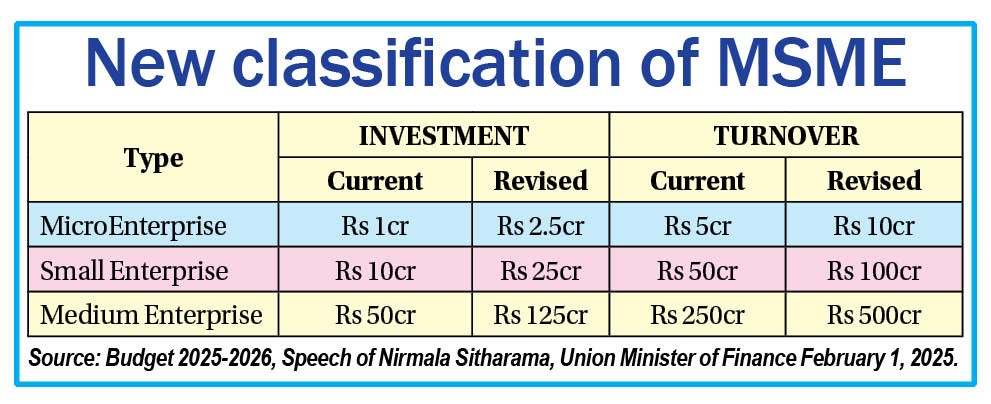
The MSME sector, often described as the backbone of the Indian economy, has gained renewed policy attention under the broader vision of Viksit Bharat@2047. In April 2025, the government revised MSME classification thresholds to allow firms to grow without losing access to benefits tied to their status. This move is aimed at reducing the fear of “graduation penalties” and encouraging enterprises to scale operations sustainably.
Driving India’s Growth Engine
MSMEs play a central role in India’s structural transformation by promoting decentralized industrialization and shifting labor from agriculture to manufacturing and services. According to the Economic Survey 2025–26, the sector contributes 31.1% to GDP and 35.4% to total manufacturing output, with over 7.47 crore registered enterprises forming a vast economic base.
India’s small businesses are also emerging as a key force in global trade. Their integration into Global Value Chains (GVCs) has strengthened export competitiveness, with MSMEs accounting for 48.55% of merchandise exports in FY25. Policy support, including the ₹25,060 crore Export Promotion Mission and a ₹20,000 crore collateral-free credit guarantee scheme, has further accelerated this momentum.
Beyond macroeconomic contributions, MSMEs are critical for employment generation and social inclusion. Employing over 32.82 crore individuals, the sector is the second-largest employer after agriculture. It enables localized job creation, supports first-generation entrepreneurs, and reduces regional disparities.
Digital and Financial Transformation
The rapid adoption of digital public infrastructure is reshaping MSME operations. Platforms such as the Open Network for Digital Commerce (ONDC) are lowering entry barriers and enabling direct market access. Initiatives like the TEAM platform and applications such as Namma Yatri demonstrate how digital ecosystems can reduce dependence on traditional intermediaries.
Simultaneously, financial innovation is addressing long-standing credit gaps. The shift towards cash-flow-based lending, supported by frameworks like the Account Aggregator system, Open Credit Enablement Network (OCEN), and the RBI’s Unified Lending Interface (ULI), is transforming credit access. These tools allow lenders to assess real-time business performance, particularly benefiting asset-light enterprises.
MSMEs are also playing an important role in India’s green transition. Schemes like MSE-GIFT, offering interest subvention for renewable energy adoption, are encouraging sustainable practices. Additionally, targeted solar financing initiatives are helping small manufacturers reduce energy costs while aligning with climate goals.
Emerging Role in Innovation and Traditional Sectors
The sector is gradually moving beyond low-value manufacturing into high-tech and strategic domains such as defense and aerospace. Government initiatives, including a ₹10,000 crore SME Growth Fund and the Self-Reliant India (SRI) Fund—which has already infused ₹15,442 crore into 682 MSMEs—are supporting this transition.
At the same time, traditional sectors are being revitalized. The PM Vishwakarma Scheme has registered 30 lakh artisans and trained over 23 lakh by 2025, with ₹2,257 crore disbursed as collateral-free loans. This effort is integrating informal artisans into formal economic systems while preserving cultural industries.
Persistent Structural Challenges
Despite these advancements, significant bottlenecks remain. The MSME sector faces a substantial credit gap of approximately ₹30 lakh crore, as highlighted by a 2025 SIDBI-Crisil report. About 35% of enterprises remain unregistered, limiting their access to formal financial systems.
Delayed payments continue to be a major concern. As of March 2024, over ₹20,413 crore was locked in pending cases on the Samadhaan portal, with payment cycles extending beyond 120 days in 2026. This severely disrupts cash flows for small suppliers.
Global uncertainties have also exposed MSMEs to supply chain disruptions. Following geopolitical tensions in West Asia in early 2026, shipping costs surged dramatically—from $300 to over $8,500 on certain routes—prompting the government to introduce the RELIEF scheme to offset logistical costs.
Other challenges include limited access to equity financing, high compliance burdens (estimated at ₹13–17 lakh annually for manufacturing MSMEs), and a widening digital divide. While over 90% of MSMEs accept digital payments, only 18% have accessed digital credit and just 13% actively use digital marketing tools.
Gender disparities further compound these issues. Although 26.2% of MSMEs are women-led, their access to formal credit remains lower, with a higher reliance on informal financing sources.
Policy Roadmap for Sustainable Growth
Addressing these challenges requires a multi-pronged approach. Transitioning to algorithmic, cash-flow-based lending can unlock credit for asset-light enterprises. Mandating participation in Trade Receivables Discounting Systems (TReDS) can reduce payment delays by enabling invoice-based financing.
Investment in cluster-based Common Facility Centres (CFCs) can provide MSMEs with access to advanced manufacturing technologies without heavy capital expenditure. Simplifying compliance through unified reporting frameworks and “green channel” regulatory systems can reduce administrative burdens.
Leveraging ONDC for export integration can democratize global market access, while strengthening Zero Defect Zero Effect (ZED) certification can enhance quality and sustainability standards. Expanding equity financing through patient capital instruments and revenue-based financing models can further support scalable enterprises.
Conclusion
India’s MSME sector stands at a critical juncture. Transitioning from fragmented resilience to globally competitive scale is essential for achieving the Viksit Bharat@2047 vision. By addressing structural constraints such as the “missing middle,” improving credit access, and strengthening digital ecosystems, MSMEs can evolve into powerful drivers of growth, innovation, and global competitiveness.
Also read : India’s Evolving Digital Regulatory Architecture: Building a Future-Ready Governance Framework
Do follow : MSMEs: From survival to scale