
Between 2002 and 2025, there were 45 exam paper leaks affecting examinations with over 100,000 candidates, yet only 2 cases resulted in convictions.
Two Decades of Exam Paper Leaks: 45 Major Cases, Only Two Convictions, and Millions of Aspirants Left Waiting
From NEET and CBSE Controversies to Recruitment Exam Scandals, a Review of Cases Between 2002 and 2025 Reveals Persistent Delays, Limited Accountability, and Evolving Leak Networks
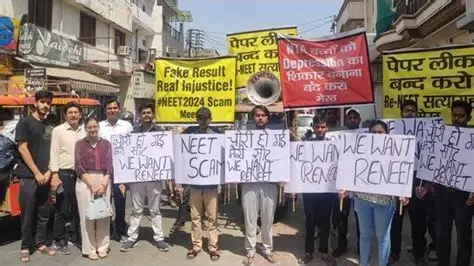
For the 22 lakh medical aspirants whose academic plans were disrupted pending the NEET-UG retest on June 21, and for the 4 lakh CBSE students caught in uncertainty after questions emerged regarding a revised marking system, the challenge today extends beyond academic performance. Increasingly, it is a test of confidence in the institutions responsible for conducting some of India’s most important examinations.
Although administrative action has occasionally followed public outrage—such as the transfer of senior officials including the CBSE Chairman and Secretary—the long-term record suggests that accountability in examination-related controversies remains limited once public attention fades.
An examination of 45 major exam paper leak cases between 2002 and 2025, each involving examinations with more than one lakh applicants or candidates, presents a striking picture. Despite the scale of these incidents and their impact on millions of people, only two cases have resulted in convictions. Most of the remaining cases continue to face prolonged legal proceedings, remain under investigation, or have reached dead ends. In a notable reflection of the system’s challenges, two individuals accused in examination leak cases currently serve as Members of the Legislative Assembly (MLAs) in Uttar Pradesh.
The review of case records spanning 2002 to 2025 covered 27 recruitment examinations and 18 higher-education entrance tests and school board examinations. Discussions with investigators and senior government officials, along with scrutiny of official records, reveal that at least 1,658 individuals were arrested, 925 were charge-sheeted, 18 were convicted across two cases, 32 were acquitted in two separate cases, and 43 accused persons remain in judicial custody. Despite the large number of arrests and investigations, action against senior officials has been comparatively limited.
The Human Cost Behind the Statistics
Beyond the legal numbers lies a far larger impact on candidates. More than 3.86 crore aspirants registered for these examinations, seeking employment opportunities, admissions to educational institutions, or strong board examination results. Many of them experienced significant delays after examinations were cancelled and rescheduled.
Records indicate that retests for cancelled examinations took an average of 183 days to be scheduled. In some cases, candidates waited for years before fresh examinations were conducted, causing major disruptions to educational plans, career trajectories, and personal lives.
Among the 45 identified paper leak cases, 23 occurred during BJP-led governments at either the Centre or state level, 14 took place under Congress-led administrations, while the remaining incidents occurred under governments led by other political parties. State-wise, Uttar Pradesh recorded the highest number of leaks with 11 cases, followed by Rajasthan with seven and Gujarat with three.
Many of these cases have remained in trial courts for years. Several accused individuals secured bail while proceedings continued, and in numerous instances investigating agencies either declared suspects untraceable or submitted closure reports.
Meanwhile, investigators say examination leak networks have continually adapted their methods. What began with fax-based transmission of question papers in the early 2000s has evolved into the use of Bluetooth devices, remote-access software, compromised printing facilities, and sophisticated logistical manipulation by the 2020s.
Two Decades, Convictions in Only Two Cases
Official records show that the only two cases resulting in convictions involved Railway Recruitment Board (RRB) examinations.
The first case concerned a paper leak that occurred in 2002. On July 21, 2025, a CBI Special Court in Ahmedabad convicted seven railway officials and one Railway Protection Force constable. Investigators traced the leak to serving officials posted in Ahmedabad, Vadodara, and Anand in Gujarat.
Each convicted individual received a sentence of five years’ rigorous imprisonment and a fine of ₹5 lakh. All are currently on bail, and their appeals remain pending before the Gujarat High Court. The examination, scheduled for August 18, 2002, for recruitment to the post of Probationary Assistant Station Master, had attracted more than one lakh applicants and was cancelled a day before it was to be held. A fresh examination was conducted a year later.
The second conviction arose from a 2010 RRB examination leak case. On January 30, 2024, a CBI court in Hyderabad sentenced former RRB Mumbai Chairman Satendra Mohan Sharma, his son, and eight others to five years’ rigorous imprisonment, along with a combined fine of ₹7.87 lakh. Sharma later secured bail from the Telangana High Court on February 2, 2024.
The examination had attracted nearly five lakh applicants for the posts of Assistant Loco Pilot and Assistant Station Master. Originally scheduled for June 6 and June 13, 2010, it was cancelled after the leak surfaced and was eventually conducted again in July 2011.
Key Trials Remain Stuck
Several high-profile cases continue to remain unresolved despite the passage of years.
The 2003 CAT paper leak, which led to the first-ever retest for the entrance examination to the Indian Institutes of Management (IIMs), resulted in the arrest of key accused Ranjit Don, also known as Kumar Suman Singh and Indrajeet Kumar. The incident led to the formation of the V.K. Shunglu Committee, which examined systemic weaknesses and recommended reforms. More than 1.25 lakh candidates had applied for the examination held on November 23, 2003, while the retest took place in February 2004.
The 2006 Railway Group-D paper leak case remains at the witness stage despite 142 court listings between 2012 and 2026. Two accused individuals in the case, Bedi Ram and Vipin Dubey, are currently MLAs in Uttar Pradesh.
Bedi Ram, an SBSP MLA from Jakhania (SC) in Ghazipur district, faces multiple cases related to railway recruitment leaks, MP Public Service Commission examination leaks, and a police recruitment leak. Vipin Dubey, a NISHAD Party MLA from Gyanpur in Bhadohi district, has also been booked under the Gangsters Act in connection with the same case.
The examination had nearly 16 lakh candidates enrolled before being cancelled in February 2006 and later conducted in July 2006. A Lucknow court issued non-bailable warrants against both leaders on July 11, 2024, rejected their discharge applications, and framed charges on July 26, 2024. Proceedings remain pending.
Recent Cases and Judicial Concerns
The 2015 UPPSC Preliminary Examination leak, the 2016 UPPSC Review Officer and Assistant Review Officer leak, the 2017 Himachal Pradesh Board leak, the NEET-UG 2024 leak, and the UGC-NET 2024 controversy all remain subjects of investigation, judicial scrutiny, or ongoing court proceedings.
The NEET-UG 2024 leak, linked to Patna and Hazaribagh, resulted in multiple charge sheets against approximately 46 individuals by the end of 2024. The matter remains pending before a Special CBI Court in Patna. The examination had 23.33 lakh applicants, was conducted on May 5, 2024, and later reconducted on July 23, 2024.
Courts have also expressed concern in several cases. In May 2026, a Delhi court criticised the CBI in the UGC-NET 2024 case for filing closure reports despite what the court considered evidence of a leak.
Similarly, while hearing a 2021 Rajasthan Sub-Inspector recruitment examination leak case, Justice Sameer Jain of the Rajasthan High Court observed on August 28, 2025, that the participation of certain members suggested systemic corruption within the Rajasthan Public Service Commission (RPSC). Following the judgment, one member remained on bail while two others resigned.
Leak Networks Find New Loopholes
Investigators believe legal delays are partly linked to the provisions under which paper leak cases are registered. Many cases have traditionally been filed under IPC provisions relating to cheating, forgery, and criminal conspiracy, offences that do not always impose stringent bail restrictions.
At the same time, leak networks have become increasingly sophisticated. From fax transmissions in the 2002 RRB case, operations evolved to include messaging applications, Bluetooth devices, compromised transport systems, shell printing companies, and remote-access software such as TeamViewer.
The 2024 UP Police Constable leak allegedly involved manipulation of sealed transportation trunks, while the 2023 Bihar Police Constable leak reportedly involved diversion of examination papers to an unauthorized warehouse. Investigators have also reported instances where remote-access software enabled off-site individuals to control candidates’ computer systems during examinations.
Even within examination centres, vulnerabilities remain. In the 2015 UPPCS Preliminary Examination leak, question papers were allegedly photographed before the examination began. In the 2022 Bihar PSC Preliminary Examination, investigators found that certain candidates had allegedly been isolated in a locked room to solve leaked question papers.
According to investigators, printing presses and outsourced logistics systems continue to represent some of the most vulnerable points in the examination process, underscoring the continuing challenge of safeguarding the integrity of large-scale examinations across the country.
Do follow: Who will be held accountable for exam paper leaks? Don’t bet on it, records show most get away
Also read :Building a Resilient Health Sector in India: Strategies for a Stronger Future