
Rural unemployment rose from 4.6% in April to 5.1% in May, while urban unemployment saw a slight decline from 6.6% to 6.4% during the same period.
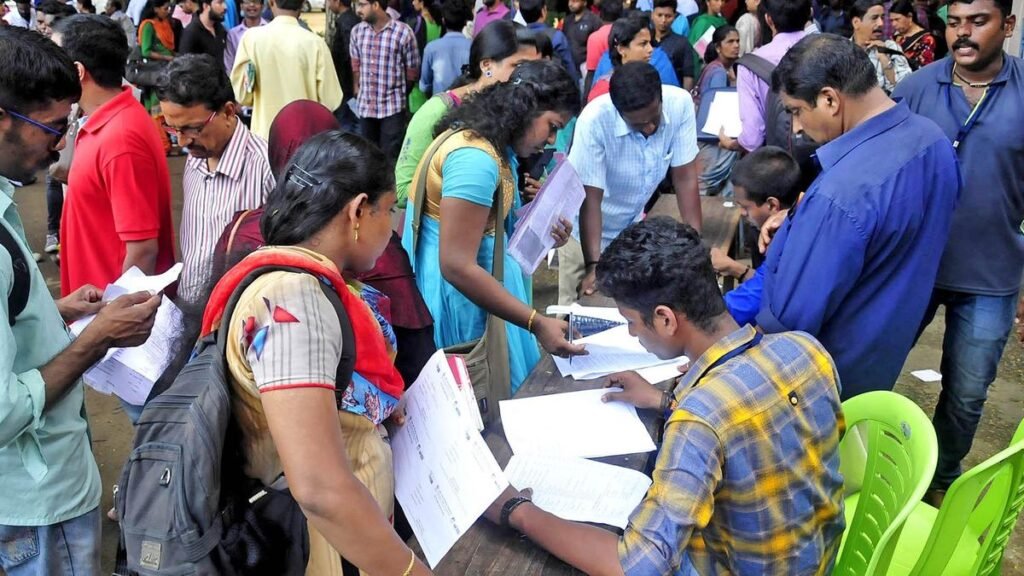
India’s unemployment rate rose to an 11-month high of 5.5 per cent in May 2026, up from 5.2 per cent in April 2026, indicating a moderation in labour market conditions amid a decline in workforce participation, according to the latest monthly bulletin of the Periodic Labour Force Survey (PLFS) released by the National Statistics Office (NSO) on Monday.
The report showed that the increase in unemployment coincided with a fall in the Labour Force Participation Rate (LFPR), a key indicator that measures the proportion of the population that is either employed or actively seeking employment. The LFPR dropped to 54.4 per cent in May, marking its lowest level in 11 months, compared to 55 per cent in April.
A decline in labour force participation generally indicates that a smaller share of the population is engaged in the labour market, either through employment or active job search. The latest PLFS data suggest that both rural and urban areas witnessed a reduction in workforce participation during the month under review.
In rural India, the LFPR declined to 56.6 per cent in May from 57.5 per cent in April, reflecting a significant fall in labour market participation. Urban areas also recorded a decline, though comparatively modest, with the LFPR easing to 49.8 per cent from 50.1 per cent in the previous month.
The unemployment estimates in the PLFS bulletin are based on the Current Weekly Status (CWS) approach. Under this methodology, an individual’s activity status is determined with reference to the seven days preceding the date of the survey. A person is classified as unemployed if he or she did not work even for one hour on any day during the reference week but either sought employment or was available for work for at least one hour on any day during that period.
The data further revealed a rise in unemployment across both genders. Among men, the unemployment rate increased to 5.4 per cent in May, compared with 5.1 per cent in April, indicating a gradual deterioration in employment conditions during the month.
Similarly, the unemployment rate among women also moved higher. Female unemployment stood at 5.6 per cent in May, up from 5.4 per cent recorded in April. The increase suggests that employment opportunities weakened for both men and women during the period under review.
The latest figures come as the government continues to monitor labour market trends through the revamped PLFS framework. The survey’s sampling methodology was overhauled in January 2025 with the objective of generating monthly estimates of major employment and unemployment indicators for both rural and urban areas at the all-India level using the CWS approach.
The revised methodology enables more frequent tracking of labour market developments and provides policymakers with timely information on employment trends across the country. The monthly estimates are intended to complement the broader labour market assessment and facilitate evidence-based policy interventions.
The May 2026 bulletin indicates that while labour market participation weakened, unemployment edged higher, resulting in the highest jobless rate recorded in the past 11 months. The simultaneous rise in unemployment and decline in labour force participation points to softer labour market conditions during the month.
The PLFS remains the principal source of employment and unemployment statistics in India, and its monthly releases provide critical insights into workforce dynamics, labour participation patterns, and job market conditions across rural and urban regions of the country.
Conclusion:
The latest PLFS data for May 2026 indicate a moderation in India’s labour market, with the unemployment rate rising to an 11-month high of 5.5 per cent while labour force participation fell to an 11-month low of 54.4 per cent. The increase in joblessness among both men and women, coupled with declining workforce participation in rural and urban areas, suggests that employment conditions weakened during the month. Although the changes were relatively modest, the simultaneous rise in unemployment and decline in labour force participation point to a softer labour market environment. The findings underscore the importance of closely monitoring employment trends in the coming months to assess whether the May figures represent a temporary fluctuation or the beginning of a broader slowdown in labour market activity.
Do follow: Marginal increase in unemployment rate in May
Also read: Anyone Trying to Distort NEET-UG 2026 Retest Will Face Full Force of Law, Says Cabinet Secretary