
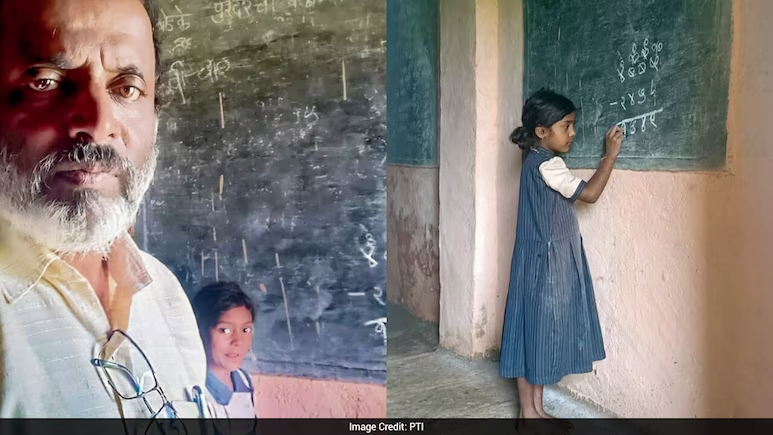
A 55-year-old teacher in Maharashtra’s Kolhapur district has become an example of dedication to rural education by walking nearly 5 kilometres through dense forest every day to reach a remote school where only one student is currently enrolled. Jivan Mithari has continued teaching at the Zilla Parishad school in Kawaltek Dhangarwada despite the lack of a motorable road, electricity and the risks posed by wildlife.
Mithari has been posted at the school for the past 13 years. The school is located in a remote hamlet in Gaganbawada taluka, close to the Kolhapur-Sindhudurg border. Since vehicles cannot reach the school, Mithari walks about 2.5 kilometres each way from the nearest accessible road, making his daily journey around 5 kilometres.
Teacher Continues Journey Despite Difficult Terrain
The route to the school passes through dense forest and becomes particularly challenging during Maharashtra’s heavy monsoon. Mithari has to deal with rain, slippery paths and encounters with wild animals, including gaurs and leopards reported in the area.
Despite the risks, Mithari has continued making the journey every working day. He said he joined the school on July 26, 2013, and has remained there since then. His decision to continue at the remote posting reflects his belief that even a single child should not be deprived of access to education.
School Now Has Only One Enrolled Student
The school once served a larger population, but the number of students gradually declined as families from the hamlet migrated towards Kolhapur city in search of better livelihood opportunities.
At present, Class 3 student Swara Bodake is the only officially enrolled student at the school. Her younger sister also attends classes informally because the hamlet does not have an anganwadi centre.
The declining student population highlights a larger challenge facing schools in remote and sparsely populated areas, where migration can leave government institutions with very few students while basic infrastructure remains limited.
Mithari Chose the Remote Posting
Mithari’s association with the school was not simply the result of an unwanted posting. Before joining the remote institution, he had served as chairman of the Kolhapur District Primary Teachers’ Cooperative Bank.
According to his account, some colleagues believed that teachers in influential positions usually managed to secure more convenient postings. Mithari instead accepted the difficult assignment and chose to work at the remote school.
Over the years, the school’s circumstances changed as the local population declined. However, Mithari continued to report to work even as the number of students fell to just one.
Wildlife Adds to Daily Challenge
The forest surrounding the school is home to several wild animals, making Mithari’s commute more than just a difficult trek. He has encountered gaurs during his journey, while leopards have also been spotted in the vicinity.
Mithari has said that villagers have taught him how to respond when he encounters wildlife. Although the journey can sometimes be frightening, he has become accustomed to the route and continues to make the trek to ensure that the student’s education does not stop.
Rural Education Challenges Highlighted
Mithari’s story comes against the backdrop of continuing challenges in providing education to children living in remote areas. Limited road connectivity, lack of electricity, migration and very low enrolment can make it difficult to sustain schools in isolated communities.
Yet, the school continues to function because there is still a child who needs access to education. Mithari’s daily journey demonstrates the role individual teachers can play in keeping educational services available in areas where infrastructure and population density make schooling difficult.
For Mithari, the number of students does not determine the importance of his responsibility. As he put it, even if there is only one child, he has to continue his work.