
Uniform Debate Heats Up: Are Schools Policing Discipline or Dictating Choice?
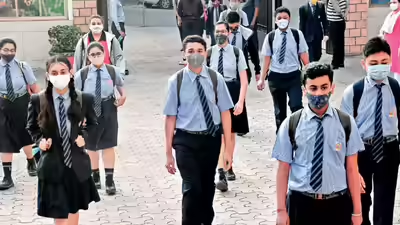
A quiet corner of Ahmedabad turned into a flashpoint this week when Satyamev Jayate International School found itself in the middle of a heated controversy. The reason? A ban on girl students wearing leggings under their skirts — a seemingly small policy change in Ahmedabad school that has snowballed into a full-blown debate on discipline, modesty, and gender sensitivity in Indian schools.
Parents, education officials, and activists are now questioning whether the move promotes uniformity or infringes upon personal comfort and dignity.
The Rule That Sparked a Storm
According to reports, the private CBSE-affiliated Ahmedabad school circulated a notice earlier this week asking girl students not to wear leggings, stockings, or tights beneath their skirts. The school management claimed the rule was introduced to “maintain uniform discipline” and “avoid deviations from prescribed dress code.”
However, for many parents, the policy felt regressive and disconnected from practical reality. Ahmedabad’s temperature can swing widely — from 45°C summers to chilly winters — and leggings often serve both comfort and modesty purposes.
Within hours of the announcement, parent groups flooded social media with concerns, calling the decision “unnecessary policing” and “an insult to students’ dignity.”
One parent wrote on X (formerly Twitter):
“Instead of focusing on education and safety, schools are moral policing girls for what they wear. My daughter is 12 — she deserves comfort, not judgement.”
Ahmedabad Parents Demand Answers
A group of aggrieved parents reached out to the District Education Officer (DEO), alleging that the rule was discriminatory and targeted only female students. “If the goal is equality, why not revise the boys’ dress code too?” one mother asked during a meeting held outside the school gates.
The DEO responded swiftly, issuing a show-cause notice to the school management and ordering an inspection. “Any school imposing unreasonable dress code restrictions will face action,” an official told The Times of India.
Meanwhile, the Ahmedabad school management has defended its decision, stating that the rule was “misinterpreted.” A spokesperson explained that the intent was not to discriminate but to “standardize uniforms and maintain discipline within the school environment.”
Still, for many families, the explanation did little to calm tempers.
A Larger Question: Whose Definition of ‘Decency’?
This incident has reignited a broader conversation that India’s education system grapples with regularly — the fine line between discipline and personal freedom.
Education experts note that dress codes are meant to encourage equality, minimizing visible socioeconomic differences among students. Yet, they argue, such policies must evolve with time.
Dr. Rupal Desai, a child psychologist based in Ahmedabad, commented:
Many parents share this sentiment, fearing that such restrictions send the wrong message to young students. In an age when conversations around consent, confidence, and equality are expanding, rigid dress codes appear increasingly outdated.
Dress Codes and Gender Bias in Indian Schools
Incidents like this are not new. Across India, schools have occasionally faced backlash for sexist or ill-conceived uniform policies — from banning ponytails and sleeveless tops to dictating skirt lengths. In 2023, a Delhi school’s decision to enforce a “no-makeup, no accessories” rule led to similar protests.
Critics argue that these policies disproportionately target girls, holding them accountable for maintaining “decorum,” while boys rarely face equivalent scrutiny.
According to education activist Nidhi Joshi,
“Every time a school issues such a circular, it reinforces a culture of control over girls’ bodies. We need to move from regulation to respect.”
Government Response and the Road Ahead
Following the public outrage, the Gujarat State Education Department has directed all schools to review their uniform guidelines to ensure they align with principles of equality and practicality. Officials emphasized that comfort, climate, and cultural context should guide school dress codes.
As of now, the investigation into Satyamev Jayate International School’s directive is ongoing. The DEO’s report, expected later this week, will determine whether the policy violated student rights under the Right to Education Act or any state education norms.
Conclusion: Time to Rethink “Uniformity”
The Ahmedabad leggings ban is more than a local controversy — it’s a mirror reflecting the contradictions of modern schooling. On one hand, schools aim to uphold discipline and tradition; on the other, students and parents seek autonomy, comfort, and fairness.
As India strides toward a more inclusive education system, the real lesson may lie not in enforcing rules but in re-examining why those rules exist in the first place.
Uniformity should unite — not restrict.
Also Read: https://thenewstudent.com/wp-admin/post.php?post=4121&action=edit
https://www.thehindu.com/news/international/pakistan-and-afghanistan-agree-to-immediate-ceasefire-during-talks-mediator-qatar-says/article70180815.ece