
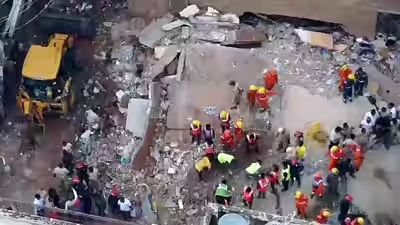
A building collapse in Delhi’s Satya Niketan, a locality widely known for housing students from Delhi University and nearby colleges, has brought renewed attention to the safety of private paying guest (PG) accommodations used by students.
A five-storey building operating as a boys’ PG accommodation collapsed on Sunday afternoon, trapping several people under the debris and leaving multiple people dead and injured. The incident occurred close to Delhi University’s South Campus, making it particularly significant for the city’s student community.
Student Accommodation Under Safety Scrutiny
Satya Niketan has developed into a major student housing hub because of its proximity to Delhi University’s South Campus. Over the years, residential properties in the area have increasingly been converted or expanded into PG accommodations and private hostels to meet demand from students arriving in Delhi from different parts of the country.
The latest collapse has raised questions over whether adequate structural inspections are being conducted before such properties are used to accommodate large numbers of students.
Students living in the collapsed building reportedly said that the structure had previously been considered unsafe and had been vacated. They also alleged that the property was subsequently allowed to operate as a PG. These claims remain part of the ongoing investigation and have not independently established responsibility for the collapse.
Basement Repair Work Under Investigation
Preliminary investigations have focused on repair or construction activity reportedly taking place in the building’s basement before the collapse.
Investigators are examining whether construction work, combined with water accumulation in the basement and possible structural weaknesses, contributed to the failure of the building. Officials have also raised questions about whether modifications to the property were carried out in accordance with applicable regulations.
The building’s condition and the exact sequence of events leading to the collapse are expected to become clearer as the investigation progresses.
Growing Concern Over Student Safety
The tragedy has highlighted a broader issue faced by students moving to Delhi for higher education: access to affordable accommodation does not always guarantee safe accommodation.
With limited institutional housing available for the large student population around Delhi University, many students depend on privately operated PGs and hostels. Areas such as Satya Niketan have consequently witnessed rapid growth in student housing, putting additional pressure on existing residential infrastructure.
The incident has therefore raised questions not only about the individual building but also about the mechanisms used to monitor the safety of student accommodations across the city.
Authorities Face Questions Over Safety Checks
Following the collapse, authorities began examining nearby structures as a precautionary measure. The Municipal Corporation of Delhi also ordered action against an adjoining property after identifying it as being in a dangerous condition.
The Delhi High Court has since sought a high-level inquiry into the incident and called for greater scrutiny of PG accommodations, including a safety audit. The court also raised concerns about the shortage of accommodation for students coming from outside Delhi and their dependence on private housing.
A Wake-Up Call for Delhi’s Education Infrastructure
The Satya Niketan tragedy has exposed an important gap in the wider education ecosystem. Student safety does not end at the gates of a university or college; it also depends on whether the housing and infrastructure surrounding educational institutions are safe.
For thousands of students who relocate to Delhi for higher education, PGs and private hostels effectively become their homes. The incident has therefore intensified calls for stronger structural inspections, transparent safety certifications and stricter monitoring of student accommodation.
As investigations continue, the central question remains whether existing safety mechanisms are sufficient to protect students living in privately operated accommodation near major educational institutions.