
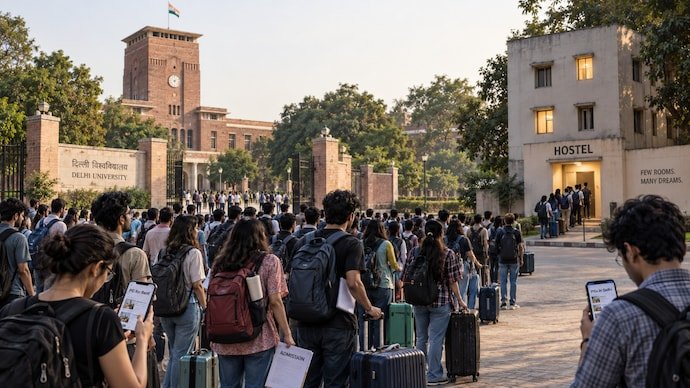
The National Human Rights Commission (NHRC) has taken cognisance of the shortage of safe and affordable hostel accommodation for students at the University of Delhi (DU), days after the fatal Satya Niketan paying guest (PG) building collapse. The rights panel has sought a concrete action plan from authorities within four weeks to address the shortage and improve existing hostel facilities.
The intervention has brought renewed attention to the dependence of students, particularly those arriving in Delhi from outside the city, on private PGs and hostels. The Satya Niketan tragedy has intensified concerns over whether the existing higher-education infrastructure can provide students with safe and affordable housing.
NHRC Seeks Action Plan on DU Hostel Facilities
The NHRC has directed the concerned authorities to prepare a time-bound plan for expanding hostel capacity at Delhi University and upgrading existing facilities. The commission has given authorities four weeks to submit their response.
The panel has highlighted the shortage of adequate and affordable accommodation as an issue affecting students’ access to education and their living conditions. The concern is particularly significant for students who relocate to the national capital for higher education and have limited access to university-managed accommodation.
Satya Niketan Collapse Highlights Student Housing Crisis
The NHRC’s intervention comes after a five-storey PG building in Satya Niketan collapsed on September 6, killing seven people. The building, located close to Delhi University’s South Campus, was predominantly occupied by students and other young people. Rescue operations continued into the following day as teams searched through the debris.
The incident has raised wider questions about the safety of private accommodation in neighbourhoods that have become major student housing hubs. Investigations are examining the building’s structural condition and construction-related activity before the collapse.
Students Increasingly Depend on Private PGs
Delhi University’s hostel capacity has long been insufficient to accommodate its large student population. As a result, students from outside Delhi frequently turn to privately operated PGs, rented rooms and hostels located around university campuses.
The shortage becomes particularly significant for students who cannot afford expensive private accommodation or who are unable to secure a place in university hostels. The Satya Niketan incident has therefore shifted the discussion from individual building safety to the wider availability of regulated student housing.
The NHRC’s intervention puts the focus on strengthening institutional accommodation so that students are not compelled to depend entirely on private housing options.
DU Hostels Need Expansion and Upgradation
Apart from increasing the number of hostel places, the authorities have also been asked to address the condition of existing facilities. Expanding capacity without improving basic infrastructure would not fully address concerns over student welfare.
The proposed action plan is expected to examine ways to increase hostel availability while upgrading accommodation facilities for students. Such measures could also reduce pressure on densely populated areas surrounding DU campuses.
Wider Focus on Student Safety After Tragedy
The Satya Niketan collapse has triggered several responses aimed at improving the safety of buildings used by students. The Delhi government has proposed structural audits of buildings in major PG hubs and a new safety framework for public-use buildings, including student accommodation.
Meanwhile, legal and administrative scrutiny of student housing has increased, with calls for stronger regulation and a comprehensive hostel policy following the deaths.
For Delhi University students, the issue is now not simply about finding affordable accommodation but ensuring that the accommodation available to them is structurally safe, properly regulated and capable of supporting their academic lives.
Hostel Infrastructure Becomes Key Higher Education Issue
The NHRC’s intervention has placed student accommodation firmly within the broader debate over higher-education infrastructure. Universities are responsible for providing academic facilities, but access to safe housing can also determine whether students are able to pursue their education without significant financial or safety risks.
The four-week deadline now puts pressure on authorities to move beyond temporary responses and present a concrete strategy for expanding and upgrading DU’s hostel network.
The developments following the Satya Niketan tragedy could therefore mark a significant moment in the discussion around student housing in Delhi, particularly for students who relocate to the capital in pursuit of higher education.