
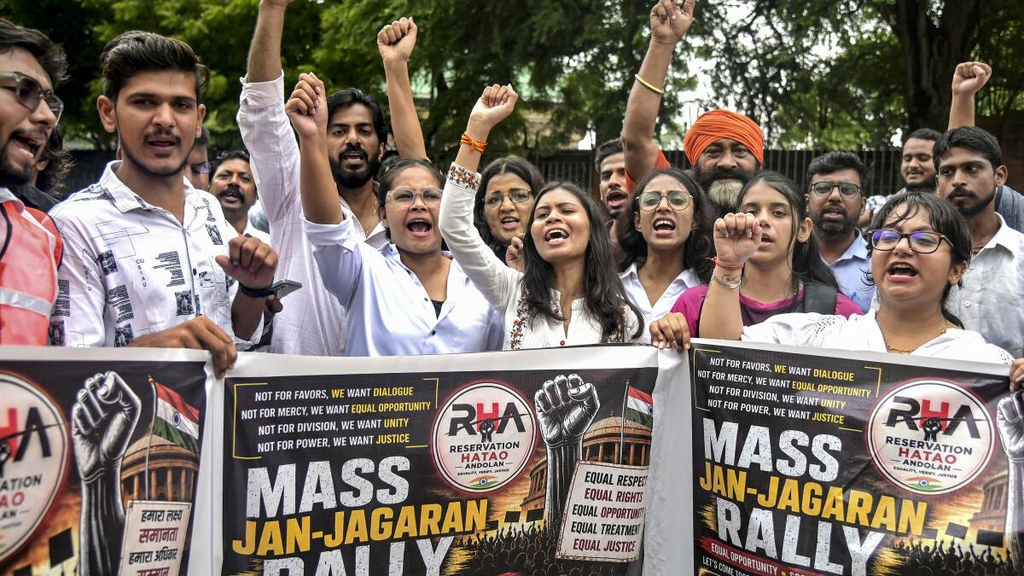
The Reservation Hatao Andolan, a campaign calling for changes to India’s caste-based reservation system in education and public employment, has triggered a wider debate over merit, social justice and the political positions of groups associated with the BJP and the broader National Democratic Alliance.
The movement, which gained momentum through social media before taking its demands to the streets, has primarily drawn support from sections of the general-category community. Its organisers have raised concerns about reservation in educational institutions and government jobs, while also demanding changes to existing laws and the creation of a commission representing the general category.
Reservation Hatao Andolan Raises Education Concerns
The campaign initially presented several demands related to the reservation system. These included limiting reservation benefits to one generation within a family, using income as a basis for reservations in education and employment, and introducing a sunset clause for reservation policies.
The movement later shifted its public messaging from the complete removal of reservation towards “reservation reform”, while adding demands including a National General Caste Commission and a review of provisions under the SC/ST (Prevention of Atrocities) Act.
For the education sector, the debate centres on whether reservation policies affect access to higher education, competitive examinations and professional courses, and how merit should be assessed alongside historical social disadvantage.
Protesters Question Reservation in Education and Jobs
Supporters of the movement have argued that reservation creates disadvantages for students in the general category during admission and recruitment processes. Some protesters have claimed that candidates with lower examination scores can secure opportunities through reserved categories while higher-scoring students may miss out.
These claims have become a central part of the movement’s messaging. However, critics argue that such comparisons can overlook the historical and structural inequalities that reservation policies were designed to address.
The debate has become particularly visible among students and aspirants preparing for examinations such as NEET and other competitive entrance tests, where access to limited seats makes the reservation question politically and socially sensitive.
BJP and ABVP Distance Themselves From Anti-Reservation Protest
The agitation has also exposed differences among political groups associated with the BJP ecosystem. The Akhil Bharatiya Vidyarthi Parishad (ABVP), the student organisation affiliated with the RSS, has publicly said it does not support the anti-reservation protests.
ABVP national president Shravan B. Raj defended reservation as a constitutional mechanism intended to promote the advancement of socio-economically marginalised communities. The organisation’s position marks a clear distinction between the student body and the demands being raised by the Reservation Hatao Andolan.
This has added another layer to the controversy, with the movement becoming a point of debate not only between political parties but also among organisations broadly situated within the larger Hindutva political ecosystem.
Differences Emerge Within NDA
The issue has also produced contrasting positions among leaders of the BJP-led National Democratic Alliance. Union Minister and Lok Janshakti Party leader Chirag Paswan has backed reservation, while NDA leader Jitan Ram Manjhi has advocated consideration of a creamy-layer mechanism for SC and ST reservation.
Paswan subsequently called for the resignation of Manjhi and his son, Bihar Minister Santosh Kumar Suman, after the latter’s comments. The disagreement reflects the political difficulty of maintaining a common position on an issue that directly affects different social and electoral constituencies.
Student Groups Highlight Caste Discrimination
The anti-reservation campaign has faced strong criticism from students belonging to Scheduled Caste and Scheduled Tribe communities. Some students have described facing caste-based assumptions and discrimination during their academic journeys.
Students have argued that reservation cannot be viewed only through marks and examination performance because access to education is also influenced by social and economic circumstances. Their experiences have added a counter-narrative to the movement’s emphasis on merit and competition.
The contrasting perspectives have brought renewed attention to the original purpose of affirmative action and whether equality in examination scores alone can address longstanding disparities in access to education.
Debate Goes Beyond Reservation
Experts cited in the debate have also linked the current agitation to broader problems involving education, unemployment and limited public-sector opportunities. With government employment becoming increasingly competitive and parts of the public sector moving towards contractual arrangements, reservation has become intertwined with wider concerns over the availability of secure opportunities.
This means the controversy cannot be viewed only as a debate over quotas. Competition for seats in universities, professional colleges and government recruitment examinations reflects a larger shortage of opportunities for young people.
Reservation Debate Remains Central to Higher Education
The Reservation Hatao Andolan has brought the long-running debate over reservation back into the spotlight, particularly among students and competitive-exam aspirants. While supporters call for greater emphasis on economic criteria and merit, critics argue that caste-based inequalities continue to justify affirmative action.
The contrasting positions within political and student organisations indicate that the issue remains highly contested. For India’s higher-education system, the challenge is to balance constitutional commitments to social justice with concerns about access, opportunity and perceptions of fairness among different sections of students.