
Reservation
Delimitation and Women’s Reservation in Legislatures: Govt Pushes Major Bills to Reshape Representation
The Union government has introduced three key Bills in Parliament aimed at redrawing India’s political map, expanding the Lok Sabha, and implementing 33% reservation for women in legislatures. The move is being seen as a major step toward electoral reform, but it has also sparked debate over its impact on federal balance and representation of states.
The proposed laws include the Constitution (One Hundred and Thirty-First Amendment) Bill, 2026, the Delimitation Bill, 2026, and the Union Territories Laws (Amendment) Bill, 2026. Together, they seek to enable fresh delimitation based on the latest available Census data, increase the strength of the Lok Sabha to 850 seats, and operationalise women’s reservation in time for the 2029 general elections.
Expansion of Lok Sabha and Constitutional Changes
The Constitution (131st Amendment) Bill, 2026 proposes to amend Article 81 to increase the maximum strength of the Lok Sabha from 550 to 850 members. Of these, 815 seats will be allocated to states and 35 to Union Territories. The aim is to ensure better representation as India’s population has grown significantly since the last seat allocation.
The Bill also removes the long-standing freeze on delimitation. Currently, Lok Sabha seats are based on the 1971 Census, while Assembly seats rely on the 2001 Census. The new amendment allows the government to proceed with delimitation using more recent Census data, likely the 2011 Census.
In addition, the Bill amends provisions related to reservation for Scheduled Castes (SCs) and Scheduled Tribes (STs), allowing future adjustments based on a Census decided by Parliament. It also enables faster implementation of the women’s reservation law by linking it directly to the completion of delimitation.
New Delimitation Commission to Redraw Boundaries
The Delimitation Bill, 2026 lays out the mechanism for carrying out this exercise. It provides for the creation of a new Delimitation Commission, which will be headed by a Supreme Court judge and include the Chief Election Commissioner and State Election Commissioners.
This Commission will be responsible for redrawing constituency boundaries and reallocating seats among states based on the latest population data. It will also decide reservations for SCs, STs, and women.
While the process will include public consultations and allow objections, the final orders of the Commission will have the force of law and cannot be challenged in court. This provision has raised concerns among some experts about transparency and accountability.
Extending Changes to Union Territories
The Union Territories Laws (Amendment) Bill, 2026 aims to apply these reforms to Union Territories with legislatures, including Delhi, Jammu and Kashmir, and Puducherry. It will ensure that women’s reservation and delimitation changes are implemented uniformly across these regions.
Women’s Reservation to Finally Take Effect
The Bills are set to activate the Nari Shakti Vandan Adhiniyam, passed in 2023, which provides 33% reservation for women in the Lok Sabha and State Assemblies. This includes a sub-quota for women within seats already reserved for SCs and STs.
The reservation will be implemented after the delimitation exercise is completed. It will also follow a rotation system, where reserved constituencies change after each delimitation cycle. The provision is initially valid for 15 years, though Parliament can extend it.
Debate Over Representation and Federal Balance
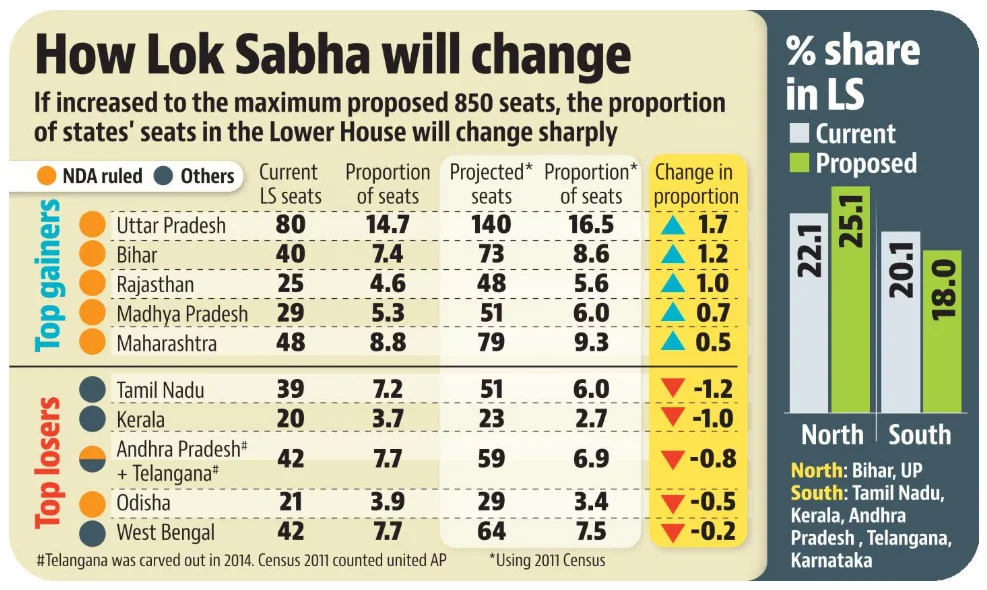
The proposed delimitation has triggered a strong debate across the country. Critics, particularly from southern states, argue that using population data for seat allocation could reduce their share in Parliament. States like Kerala and Tamil Nadu, which have successfully controlled population growth, fear losing political influence compared to more populous northern states such as Uttar Pradesh and Bihar.
There are also concerns about its impact on the federal structure. Some experts warn that increasing the representation of larger states could shift the balance of power in national politics. Questions have also been raised about possible changes in the Presidential Electoral College due to altered seat distribution.
On the other hand, supporters of the move argue that delimitation is essential to uphold the democratic principle of “one person, one vote, one value.” They point out that currently, Members of Parliament from more populous states represent far more citizens than those from smaller states, leading to unequal representation.
The government has also clarified that no state will lose its existing number of seats. Instead, all states are expected to see an increase in their total seats, with some estimates suggesting around a 50% rise.
The Road Ahead
Experts suggest that a broad political consensus will be crucial for the success of these reforms. Some have proposed a “hybrid model” that considers not just population but also factors like economic contribution and development performance.
Others have called for strengthening the Rajya Sabha to better represent states and maintain the federal balance. There are also suggestions to implement women’s reservation without linking it to delimitation, to avoid delays.
Conclusion
The government’s push for delimitation and women’s reservation marks a significant shift in India’s electoral framework. While the reforms aim to improve representation and gender inclusion, they also raise important questions about fairness and federalism. A balanced and consultative approach will be key to ensuring that the changes strengthen, rather than disrupt, India’s democratic system.
Also read: India’s Strategy to Internationalise the Rupee: Benefits, Risks, and Future Outlook
Do follow: Women’s Reservation Bill and Delimitation 2026: Key takeaways