
Origin of the ‘Cockroach Janta Party’ (CJP)
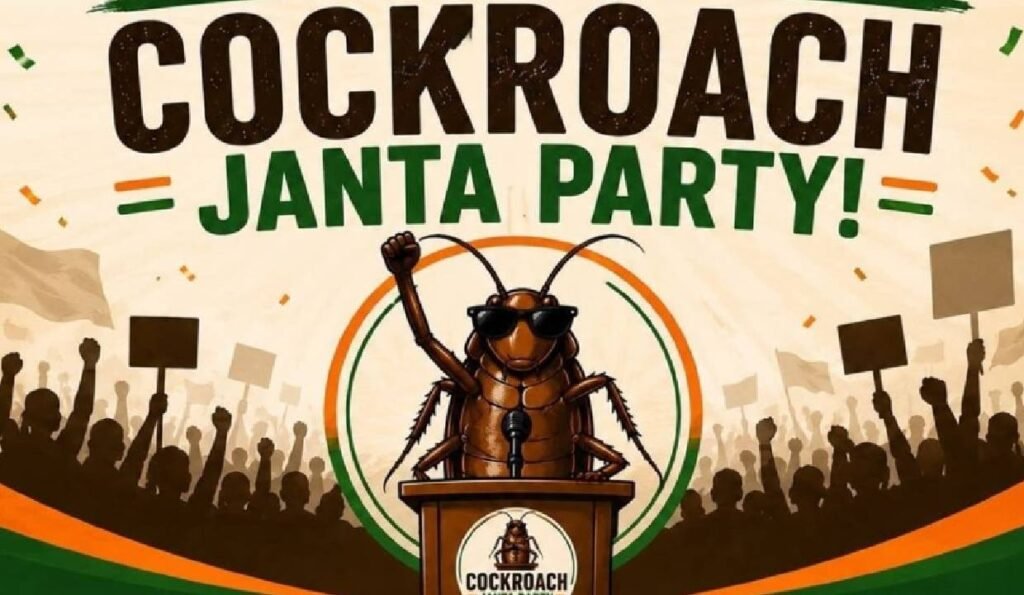
India’s political discourse recently witnessed the emergence of an unusual and highly symbolic online movement — the Cockroach Janta Party (CJP). What began as a satirical response to controversial remarks made during a Supreme Court hearing quickly transformed into a viral political phenomenon across social media platforms.
The controversy started on 15 May 2026, when Chief Justice Surya Kant, during a court hearing, allegedly remarked that some unemployed youngsters “like cockroaches” drift into journalism, social media activism, RTI campaigns and public criticism because they fail to find stable employment or professional space. The statement triggered widespread backlash online, particularly among students, journalists, activists and young internet users who viewed the comparison as insensitive and dismissive.
Although Justice Surya Kant later clarified that his remarks were aimed specifically at individuals possessing “fake and bogus degrees” rather than India’s youth as a whole, the statement had already gone viral. Social media users responded with satire, memes and political commentary, eventually giving birth to the idea of the Cockroach Janta Party.
The name itself is a sharp parody of the ruling Bharatiya Janata Party (BJP), led by Prime Minister Narendra Modi since 2014. Supporters of the satirical campaign adopted the cockroach as a symbol of resilience, survival and resistance — an insect often considered unwanted yet impossible to eliminate. Within days, the movement gained millions of online impressions, turning CJP into a viral symbol of digital dissent and youth frustration.
More than just an internet joke, the Cockroach Janta Party reflects growing conversations around unemployment, freedom of expression, media independence and the role of political satire in modern India.
In essence, the Cockroach Janta Party is not a formal political organisation but a satirical digital movement born out of controversy, public anger and internet culture. Its rapid rise demonstrates how social media can transform a single political remark into a nationwide conversation about democracy, dissent and youth identity in contemporary India.
Who Founded the Cockroach Janta Party?
The satirical movement known as the Cockroach Janta Party (CJP) was created by Abhijeet Dipke, a political communications strategist and postgraduate student at Boston University. According to reports, Dipke conceptualised the idea as an internet satire in response to the controversy surrounding remarks made during a Supreme Court hearing, never expecting it to explode into a nationwide online trend within days.
Originally from India, Dipke pursued his undergraduate studies in journalism in Pune before moving to the United States for higher education. He is currently believed to be pursuing a master’s degree in public relations at Boston University, specialising in political communication and digital media strategy.
Before beginning his studies abroad, Dipke was reportedly associated with the Aam Aadmi Party (AAP) between 2020 and 2023, where he volunteered with the party’s social media and digital outreach team. During this period, he is said to have contributed to meme-driven political campaigns and online engagement strategies, particularly during the 2020 Delhi Assembly elections won by former Delhi Chief Minister Arvind Kejriwal and the AAP.
Observers believe Dipke’s background in journalism, political messaging and internet culture played a major role in shaping the viral identity of the Cockroach Janta Party. By combining humour, satire and political commentary, the movement quickly resonated with young social media users, transforming from a meme into one of the most talked-about online political trends in India.
CJP’s Main Mission:
According to the movement’s online manifesto, CJP says its objective is to question political power, government spending and institutional transparency. The group uses satire to target what it describes as corruption, media bias and political opportunism in Indian politics.
Key Highlights From CJP’s Manifesto:
The Cockroach Janta Party’s manifesto includes several controversial and symbolic proposals, such as:
1. Post-Retirement Restrictions for Chief Justices CJP says no Chief Justice should receive a Rajya Sabha seat after retirement, arguing that judicial independence must remain free from political rewards.
2. Strict Action Over Deleted Votes The group demands harsh legal action if legitimate votes are removed from electoral rolls, claiming voting rights are central to democracy.
3. Greater Representation for Women CJP proposes: 50% reservation for women in Parliament 50% reservation for women in Cabinet positions
4. Action Against “Godi Media” The movement calls for investigations into media organisations it accuses of lacking editorial independence and being politically aligned with powerful corporate groups.
5. Ban on Political Defections According to the manifesto, MLAs or MPs switching parties should be barred from contesting elections or holding public office for 20 years
Eligibility Criteria to Join CJP
In a humorous and meme-inspired tone, the movement lists four “requirements” for supporters:
- Unemployed — “By force, by choice, or by principle”
- Lazy — “Physically only”
- Chronically Online — Active on the internet for long hours
- Able to Rant Professionally — Especially on political and social issues
Although largely satirical, these conditions are designed to connect with internet-savvy youth and digitally engaged audiences frustrated with conventional politics.
How the Cockroach Janta Party Went Viral
The Cockroach Janta Party (CJP) witnessed an explosive rise on social media within just a few days of its launch. The movement reportedly received tens of thousands of sign-ups through online forms, while the hashtag #MainBhiCockroach (“I too am a cockroach”) quickly began trending across digital platforms. The viral campaign even drew attention from opposition leaders, including Akhilesh Yadav, who referenced the trend on social media by posting “BJP v CJP.”
The movement soon extended beyond the internet, with some supporters appearing at protests and public clean-up drives dressed in cockroach-themed costumes, symbolically embracing the label that sparked the controversy.
CJP’s online popularity surged rapidly, with its Instagram account reportedly crossing 10 million followers — surpassing the official Instagram following of the ruling Bharatiya Janata Party (BJP). However, the movement’s account on X was later withheld in India following what the platform described as a legal request.
Despite its extraordinary digital momentum, political analysts note that the movement currently remains more of an internet-driven satirical phenomenon than a formal political force. India’s electoral politics continues to be dominated by established parties such as the BJP and the Indian National Congress.
CJP’s Core Message: Youth Frustration, Satire and Political Dissent
Founder Abhijeet Dipke says the Cockroach Janta Party (CJP) is not linked to any formal political organisation but represents growing frustration among young Indians over unemployment, economic pressure and political polarisation. According to Dipke, the movement aims to challenge the political establishment through satire, memes and digital activism.
Using humour and self-mockery, CJP describes itself as a platform for the “ignored” youth, with playful membership criteria such as being unemployed, chronically online and capable of “ranting professionally.” Its manifesto also targets issues like alleged voter manipulation, media bias and the relationship between politics and corporate influence.
While critics — particularly supporters of the ruling Bharatiya Janata Party — have dismissed the campaign as an opposition-backed internet trend linked to Dipke’s past association with the Aam Aadmi Party, supporters argue that the movement reflects genuine public frustration among India’s youth.
Although primarily online, the movement has already begun appearing offline, with some volunteers participating in protests dressed as cockroaches, signalling that CJP may continue evolving beyond social media satire.
Government Blocks CJP’s X Account Over Security Concerns
The Indian government reportedly ordered X to withhold the Cockroach Janta Party (CJP) account in India after intelligence agencies flagged it as a possible threat to national security. According to officials, the Ministry of Electronics and Information Technology (MeitY) acted under Section 69A of the Information Technology Act following inputs from the Intelligence Bureau (IB), which claimed the account’s “inflammatory” content was rapidly influencing young users online.
Although the account remains accessible outside India, it was blocked domestically after gaining massive popularity and crossing more than 200,000 followers on X. Following the suspension, CJP founder Abhijeet Dipke announced a new account called “Cockroach Is Back” and urged supporters to reconnect there.
Conclusion:
The rise of the Cockroach Janta Party (CJP) highlights how social media, satire and youth frustration are increasingly shaping political conversations in India. What began as an internet joke quickly evolved into a wider discussion on unemployment, freedom of expression, political accountability and the growing disconnect many young people feel from traditional politics.
Although CJP is currently more of a digital movement than a formal political force, its rapid popularity reflects the power of online communities to influence public discourse. Whether the movement sustains itself or fades with time, it has already succeeded in drawing attention to issues that resonate strongly with India’s younger generation.
Going forward, the larger challenge for political institutions and leaders will be to engage more seriously with youth concerns rather than dismissing them as online noise. At the same time, movements like CJP demonstrate that satire and digital activism are becoming important tools for political expression in modern democracies.
Do follow : India has a new political superstar – a cockroach Who Is Abhijeet Dipke, Founder Of Online Sensation Cockroach Janta Party
In ‘Cockroach Janta Party’ handle, Government sees national security threat, asks X to block
Also read: Building a Resilient Health Sector in India: Strategies for a Stronger Future