
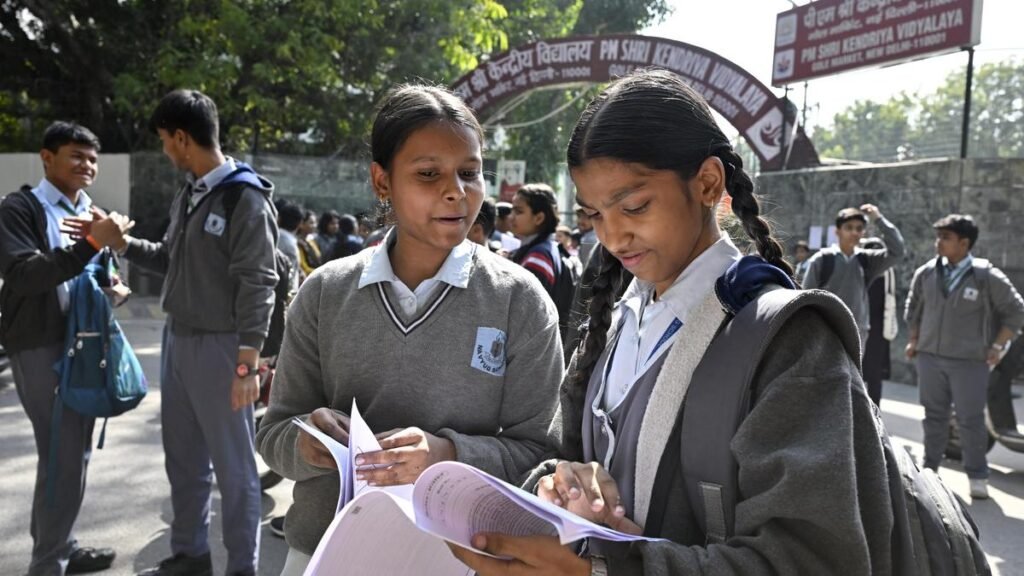
The CBSE New Third Language Rule is set to bring an important change to the assessment system for students studying in Classes 9 and 10. Starting from the 2027–28 academic session, students will have to pass an internal assessment in a third language to receive their Class 10 pass certificate.
The new policy is part of the National Education Policy (NEP) 2020, which focuses on multilingual education and aims to improve students’ communication and language skills. While the third language will not be included in the Class 10 board examination, students will still have to clear the school-based assessment conducted by their respective schools.
The announcement has generated interest among students, parents, and educators, as it changes how language learning will be evaluated in CBSE-affiliated schools.
What Is the CBSE New Third Language Rule?
Under the CBSE New Third Language Rule, schools will assess students in a third language, referred to as R3, through internal evaluations instead of a board examination.
The assessment will become mandatory for students appearing for the Class 10 board examinations from the 2027–28 academic session onwards. Students who successfully complete the assessment will be eligible to receive their Class 10 pass certificate.
Unlike subjects such as Mathematics, Science, or Social Science, the third language will not be included in the final board examination. Instead, schools will evaluate students throughout the academic year.
Why Has CBSE Introduced This Rule?
The new rule has been introduced to support the vision of the National Education Policy (NEP) 2020, which encourages multilingual learning as an essential part of school education.
According to NEP 2020, learning multiple languages helps students improve communication skills, cognitive development, and cultural awareness. It also promotes a deeper understanding of India’s linguistic diversity.
CBSE believes that regular classroom-based assessments can help students develop language proficiency without adding the pressure of another board examination. The move also encourages continuous learning instead of last-minute exam preparation.
How Will the Internal Assessment Work?
The internal assessment will be conducted by individual schools rather than CBSE.
Schools may use different methods to evaluate students, including:
- Classroom participation
- Written assignments
- Oral examinations
- Projects and presentations
- Periodic class tests
Since the assessment is school-based, teachers will monitor students’ progress throughout the academic year instead of evaluating them through a single final examination.
The exact assessment format may differ from one school to another, but all students must meet the minimum passing requirements.
What Happens If a Student Does Not Pass?
CBSE has also introduced provisions to ensure students get another opportunity if they fail the assessment.
- Students who do not pass the third language assessment in Class 9 will still be promoted to Class 10. However, they must clear the pending assessment later.
- Students who fail the assessment in Class 10 will be given another chance before the board examination results are declared.
This system allows students to improve their performance while ensuring that the third language requirement remains mandatory for certification.
How Will the New Rule Affect Students?
The CBSE New Third Language Rule means students will need to give equal importance to language learning alongside other academic subjects.
Instead of focusing only on board examinations, students will be expected to participate actively in classroom activities and complete assignments throughout the year. Consistent performance in school will become more important than relying on a single examination.
Parents may also need to monitor their child’s progress more closely, as internal assessments will directly affect eligibility for the Class 10 certificate.
Schools, meanwhile, will have greater responsibility in conducting fair and transparent evaluations while helping students improve their language skills.
Benefits of the New Third Language Rule
The policy offers several educational benefits.
- Encourages multilingual learning from an early stage.
- Improves reading, writing, speaking, and communication skills.
- Promotes continuous classroom participation.
- Reduces the pressure of another board examination.
- Supports the goals of the National Education Policy 2020.
- Encourages holistic learning instead of exam-focused preparation.
Education experts believe these changes can help students become more confident communicators while strengthening classroom learning.
Challenges That May Arise
Although the policy has several advantages, implementing it may also present challenges.
Since schools will conduct their own assessments, maintaining uniform evaluation standards across thousands of CBSE-affiliated schools could be difficult. Some parents and educators have also raised concerns about ensuring fairness and consistency in internal assessments.
Schools may need additional guidelines and teacher training to ensure that assessments are conducted objectively and uniformly.
Final Thoughts
The CBSE New Third Language Rule represents another major step in implementing the National Education Policy 2020. From the 2027–28 academic session, students will need to pass a school-based internal assessment in a third language to obtain their Class 10 pass certificate.
Although the third language will not be part of the board examination, students should not underestimate its importance. Regular participation in classroom activities, timely completion of assignments, and consistent preparation throughout the academic year will be essential.
As CBSE prepares to roll out the new policy, students, parents, and schools should stay updated with official guidelines to ensure a smooth transition. If implemented effectively, the rule could strengthen multilingual education while encouraging a more balanced and holistic approach to learning.