
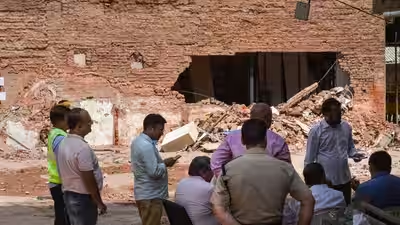
The Satya Niketan paying guest (PG) building collapse near Delhi University’s South Campus has triggered renewed concerns over the safety of student accommodation in the capital. Following the tragedy, the Akhil Bharatiya Vidyarthi Parishad (ABVP) has intensified its campaign, demanding comprehensive safety audits of PG accommodations and accountability from civic authorities.
The five-storey building, which primarily housed students, collapsed in Satya Niketan, resulting in seven deaths. The incident has raised questions over structural safety, regulatory monitoring and the condition of buildings being used as student housing in areas surrounding major universities.
ABVP Demands Safety Audit of Student PGs
The ABVP has called for immediate safety inspections of PGs and hostels used by students in Delhi. The student organisation has alleged administrative negligence and argued that safety norms for student accommodation need stronger enforcement.
As part of its campaign, ABVP representatives have taken the issue to Delhi University colleges, seeking greater accountability over the condition and approval of buildings being used to house students.
The organisation has also demanded action against senior officials of the Municipal Corporation of Delhi (MCD), including seeking the suspension of the MCD commissioner over alleged lapses in monitoring building safety.
Seven Killed in Satya Niketan Building Collapse
The tragedy occurred when a five-storey boys’ PG building in Satya Niketan collapsed on Sunday. The building was located in a densely populated area near Delhi University’s South Campus and was reportedly being used predominantly by students.
Rescue teams worked through the night and into Monday to search the debris. Seven people were ultimately reported dead, while several others were rescued from the collapsed structure.
Authorities are investigating the circumstances surrounding the collapse. Preliminary reports have pointed to the building’s structural condition, basement water accumulation and construction activity as possible factors, although the investigation will determine the exact cause.
MCD Suspends Five Officials
The incident has already led to administrative action. The MCD suspended five officials from its South Zone, including Deputy Commissioner Rakesh Kumar, following the collapse.
The move has intensified scrutiny of the civic body’s role in monitoring buildings and enforcing safety regulations in areas where large numbers of students live.
The ABVP, however, has sought further accountability and specifically called for action against the MCD commissioner.
Delhi Plans Structural Audits in PG Hubs
The tragedy has also prompted the Delhi government to consider wider reforms for buildings used as student accommodation. Authorities have proposed a new safety policy for public-use buildings, including PG accommodations, along with structural audits of buildings in major PG hubs such as Satya Niketan.
Officials have also considered the possibility of using vacant MCD and Delhi Development Authority buildings to expand accommodation options for students.
The proposed audits could become an important step in identifying structurally vulnerable buildings before they become the site of another tragedy.
Student Housing Safety Becomes a Major Education Concern
The Satya Niketan incident has highlighted a problem extending beyond one building. Thousands of students who move to Delhi for higher education depend on private PGs and hostels because institutional accommodation is limited.
For students attending Delhi University and other institutions, neighbourhoods close to campuses often become their primary residential hubs. Ensuring that these buildings meet structural and fire-safety requirements is therefore closely linked to student welfare and the broader education infrastructure.
The latest demands from the ABVP have put renewed pressure on authorities to move from post-incident action towards regular inspections and preventive safety measures.