
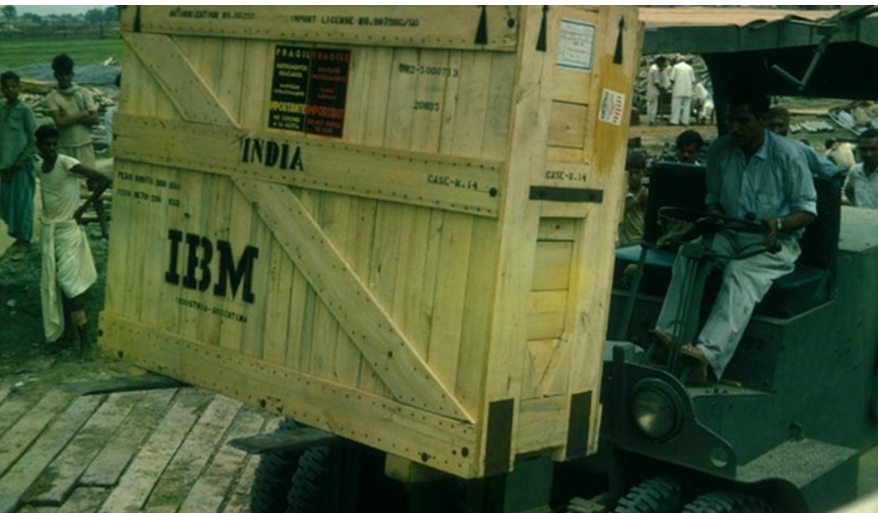
India’s journey toward becoming a global technology leader began with a remarkable event that few people know about. In 1963, India’s first educational computer, the IBM 1620, arrived at the Indian Institute of Technology (IIT) Kanpur in an unusual way, on a bullock cart. This moment marked the beginning of computer science education in India and laid the foundation for the country’s future IT revolution.
How Did India’s First Educational Computer Reach IIT Kanpur?
The IBM 1620 was imported from the United States and transported to India by air. After landing, it was moved by truck towards the IIT Kanpur campus. However, the final stretch of the journey posed a challenge because the roads leading to the newly established campus were rough and unsuitable for heavy vehicles.
To solve the problem, the machine was carefully placed on a bullock cart, which carried it safely to its destination. The image of a modern computer travelling on a traditional Indian mode of transport became a powerful symbol of India’s transition from an agricultural society to a technology-driven nation.
Why Was the IBM 1620 So Important?
The IBM 1620 became the first computer installed in an Indian educational institution. Its arrival allowed students and faculty members at IIT Kanpur to learn programming and computer science at a time when computers were still rare across the world.
The computer supported programming languages such as FORTRAN, enabling students to solve engineering and scientific problems using technology. It also introduced practical computer education, giving students hands-on experience rather than limiting learning to theory.
The Role of V. Rajaraman
One of the key figures behind this milestone was Professor V. Rajaraman, often regarded as the father of computer science education in India.
After joining IIT Kanpur in the early 1960s, Rajaraman worked to establish computer science as an academic discipline. Along with a team of Indian and international experts, he helped introduce programming courses and encouraged students to explore the emerging field of computing.
He later wrote one of India’s first textbooks on computer programming, making technical knowledge more accessible to students across the country. His efforts played a major role in shaping computer science education in India.
How Did the Computer Change Education?
The arrival of the IBM 1620 transformed IIT Kanpur into a pioneer of computer education.
Faculty members from different institutions were trained to use the computer, and programming courses were introduced for students. As interest in computing grew, IIT Kanpur launched India’s first formal academic programmes in computer science.
Many graduates who learned on the IBM 1620 later became leaders in India’s growing technology industry, contributing to research, software development, and innovation.
Why This Story Still Matters
Today, India is recognised as one of the world’s leading technology hubs. Companies founded by Indian engineers serve millions of people globally, and Indian professionals play important roles in the international technology industry.
The journey of India’s first educational computer reminds us that every technological revolution begins with a small but significant step. What started with a single computer transported on a bullock cart eventually helped build one of the largest technology ecosystems in the world.
The story also highlights the importance of investing in education, innovation, and research. Without the vision of educators and institutions willing to adopt new technology, India’s digital transformation may have taken a very different path.
Looking Ahead
The arrival of India’s first educational computer at IIT Kanpur in 1963 was more than just the delivery of a machine, it marked the beginning of a new era in Indian education. Transported on a bullock cart during the final stage of its journey, the IBM 1620 became a symbol of how tradition and technology can come together to shape the future.
Today, as India continues to advance in artificial intelligence, software development, and digital innovation, the story of that historic journey remains an inspiring reminder of the country’s remarkable technological progress.