
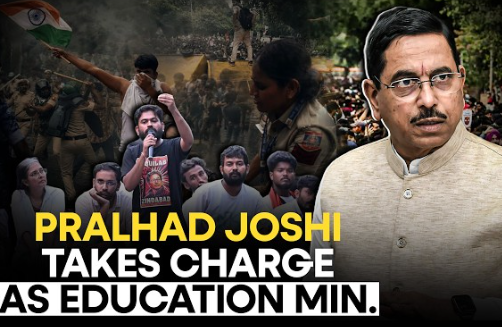
New Education Minister Begins Work Amid High Expectations
Pralhad Joshi has assumed office as India’s new Union Education Minister at a time when the country’s education system is under intense public scrutiny. His appointment follows the resignation of Dharmendra Pradhan after the NEET-UG 2026 controversy and comes amid growing calls from students, educators, and policymakers for meaningful reforms.
With millions of students preparing for competitive examinations every year, Joshi’s immediate challenge is to restore confidence in the examination system while ensuring that ongoing education reforms continue without disruption.
Rebuilding Trust in National Examinations
One of the ministry’s biggest priorities will be strengthening the credibility of national entrance examinations. The controversy surrounding NEET-UG 2026 raised concerns about examination security, transparency, and institutional accountability.
The government has already begun restructuring the National Testing Agency (NTA), introducing stricter oversight and proposing legal changes aimed at preventing future examination malpractice. Education experts believe the effectiveness of these measures will largely determine public confidence in the years ahead.
Balancing Reform With Student Expectations
The recent wave of student-led demonstrations has highlighted that young people expect more than immediate administrative action. Along with secure examinations, many have called for transparent governance, faster recruitment processes, and improved communication between educational institutions and students.
As Education Minister, Joshi is expected to engage with these concerns while ensuring that universities, schools, and examination bodies continue functioning smoothly. Observers believe that sustained dialogue with students and educational institutions will be an important part of the ministry’s approach.
Continuing the National Education Policy
Apart from addressing examination-related concerns, the ministry is expected to continue implementing the National Education Policy (NEP) 2020. Key priorities include improving learning outcomes, promoting multidisciplinary education, expanding digital learning, strengthening research, and increasing collaboration between academia and industry.
The government is also expected to focus on improving higher education governance, enhancing institutional quality, and expanding access to skill-based learning that prepares students for emerging careers.
What Students Can Expect
For students, the change in leadership does not affect current admissions or examination schedules. However, it signals a renewed focus on improving the systems that govern national examinations and higher education.
Students can expect continued efforts to strengthen examination security, improve transparency in recruitment and testing, and modernise educational institutions through ongoing reforms. Any major policy changes are expected to be announced by the Ministry of Education after consultations with stakeholders.
The Road Ahead
Pralhad Joshi takes charge at a defining moment for India’s education sector. His tenure will be closely watched not only for how the ministry responds to recent controversies but also for how effectively it implements long-term reforms.
The coming months are expected to shape the future of examination governance, higher education policy, and institutional accountability. As the ministry moves forward, restoring trust among students while advancing meaningful reforms will remain one of its biggest responsibilities.