
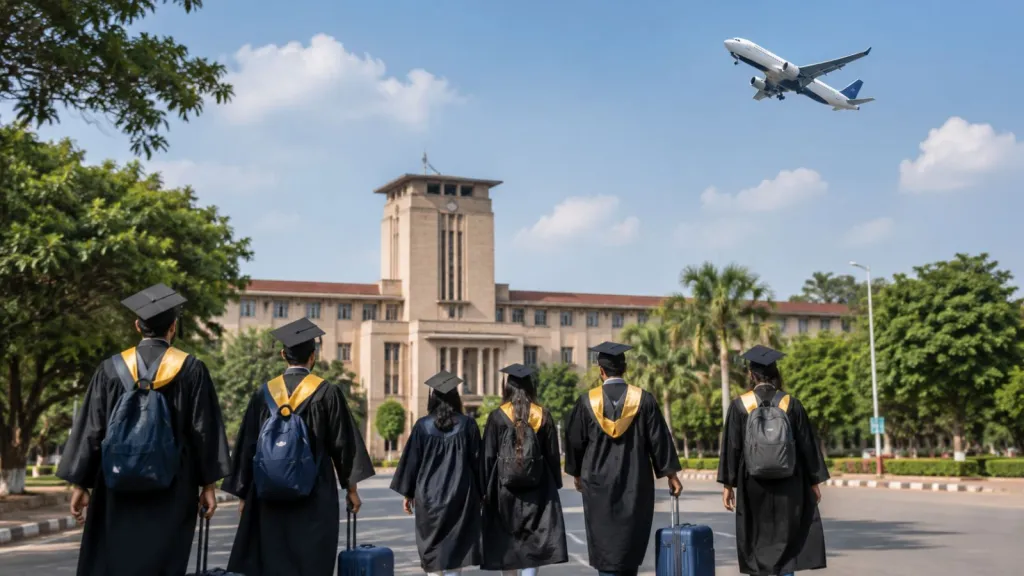
Centre Responds to IIT Brain Drain Concerns in Parliament
The issue of IIT graduates moving abroad was raised during the Monsoon Session of Parliament, where the Centre stated that pursuing higher education or employment overseas is ultimately a matter of individual choice. The response came after questions were raised about campus placements, overseas migration, and whether the government was tracking the movement of graduates from the Indian Institutes of Technology (IITs).
The Ministry of Education clarified that it does not maintain data on IIT graduates who accept campus placements in India and later relocate abroad. Instead, it emphasised that students’ career decisions are shaped by several personal and professional factors, including academic interests, career goals, financial circumstances, and international opportunities.
Government Highlights Career Support at IITs
Responding to concerns over placement outcomes, the Centre said IITs continue to strengthen career support for students through industry partnerships and skill development initiatives. Institutes regularly organise leadership talks, internships, business summits, mock interviews, soft-skills training, and career development programmes to improve students’ employability.
The ministry also highlighted the role of IIT alumni networks in connecting graduates with employers and research institutions across India and abroad. These initiatives, according to the government, are intended to prepare students for a wide range of career opportunities rather than directing them toward any specific destination.
Brain Drain Debate Continues
The discussion has once again brought attention to the long-standing debate over “brain drain”—the migration of highly skilled graduates to foreign universities and companies. While some experts believe this results in the loss of valuable talent for India, others argue that global exposure benefits both individuals and the country’s economy through research collaborations, investments, entrepreneurship, and knowledge exchange.
Many IIT graduates eventually return to India after gaining international education or work experience, while others contribute to India’s innovation ecosystem through cross-border partnerships and technology ventures.
No Official Data on Overseas Migration
During the parliamentary discussion, the Centre noted that it does not collect specific information on how many IIT graduates relocate overseas after securing placements. Instead, the ministry focused on the role of IITs in equipping students with the knowledge and skills needed to succeed in competitive global industries.
Officials reiterated that decisions related to higher education or employment abroad depend on individual aspirations and cannot be viewed solely through the lens of government policy.
What It Means for Students
For engineering aspirants, the parliamentary discussion does not signal any change in admission policies or placement procedures at IITs. However, it reflects a broader conversation about how India can retain highly skilled talent while continuing to provide graduates with opportunities to compete in an increasingly global job market.
Education experts suggest that strengthening research infrastructure, encouraging innovation, supporting start-ups, and expanding high-quality employment opportunities within India will be key to attracting and retaining top talent.
Looking Ahead
The debate over IIT graduates working abroad is likely to continue as India expands its higher education and research ecosystem. While the government views overseas education and employment as personal choices, policymakers are also expected to focus on creating conditions that encourage talented graduates to contribute to India’s long-term scientific, technological, and economic development.
As Parliament continues discussions on education and employment, the issue of balancing global mobility with domestic talent retention is expected to remain an important policy conversation.